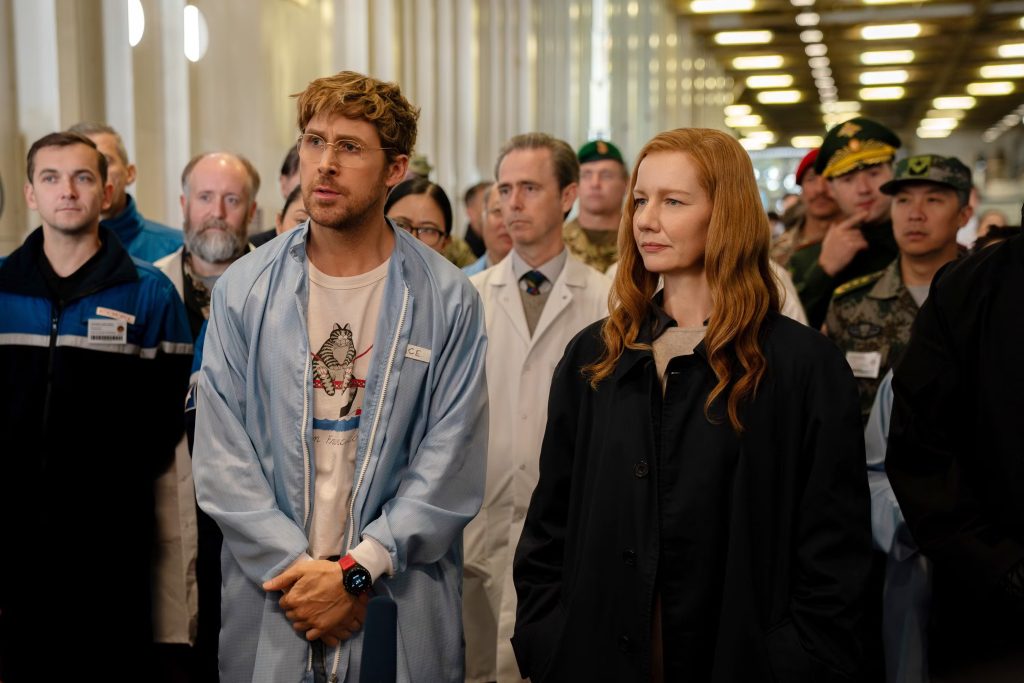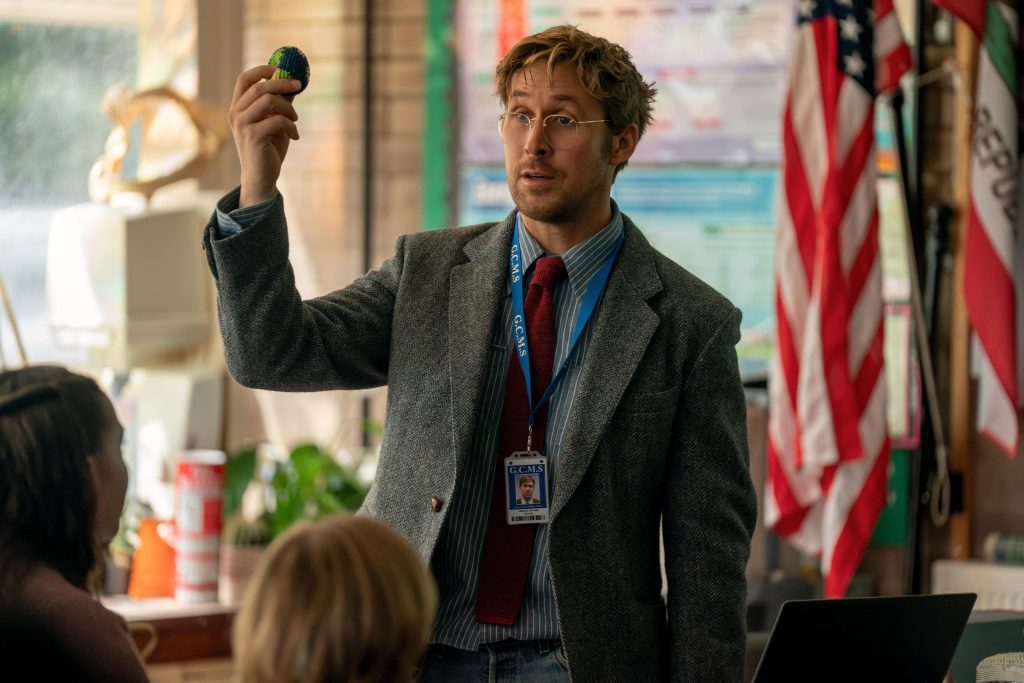
Six years in the making, $200 million on the screen, and a record-breaking debut — Project Hail Mary shows what happens when one of Hollywood’s most carefully built careers makes its boldest move.
By Teresa Greco
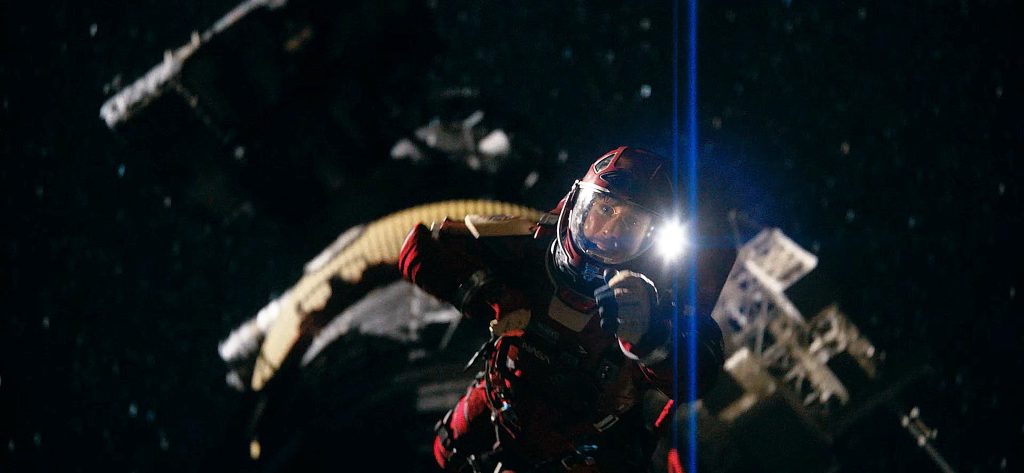
There is a moment early in Project Hail Mary when Ryan Gosling’s character wakes alone on a spacecraft with no memory of who he is, no idea where he is, and no one to help him make sense of it. It is a quiet scene with no explosions, no dramatic score, just a man blinking awake under fluorescent light, slowly realising that the survival of the human race may depend entirely on him. Without being overly literal, it also serves as a fitting metaphor for what Gosling himself has been doing for much of the past six years. Working with intention. Building momentum out of view. Constructing something the industry only fully recognised during the opening weekend of March 20, 2026.
Project Hail Mary opened to a commanding $80.5 million domestically in its first weekend, the second-largest opening ever for a non-franchise film, decisively outperforming industry projections. Critical response matched its commercial momentum, with a 95-per-cent score on Rotten Tomatoes and an A CinemaScore from opening-night audiences. Globally, the film reached $140.9 million, buoyed in part by IMAX and other premium large-format screens, which generated more than half of its domestic gross. For a release with no franchise lineage, sequel advantage, or superhero safety net, the result is exceptional, and for Gosling, it represents the return on a creative wager placed long before the market was paying attention.
THE MAN WITH A PLAN
The story of how Project Hail Mary came together reveals much about Gosling’s current position in Hollywood. He signed on to star in and produce the film in March 2020, before Andy Weir’s novel had even reached readers. Weir, whose earlier book The Martian became an Academy Award-nominated film starring Matt Damon, had quickly become one of the industry’s most closely watched science-fiction voices. When the rights to his follow-up went to market, Gosling moved decisively. He aligned himself with directors Phil Lord and Christopher Miller, known for The Lego Movie, Spider-Man: Into the Spider-Verse, and 21 Jump Street, and brought in Drew Goddard, who had adapted The Martian, to translate the story for the screen. It was a creative team assembled with precision and clarity of purpose.
Around the same period, Gosling founded General Admission with producing partner Jessie Henderson, a former Apple Original Films executive. Together they secured a first-look deal with Amazon MGM Studios. The name General Admission says it all: accessible, unpretentious, built for everyone. A company designed to make ambitious stories available to the widest possible audience. Andy Weir has often expressed an interest in narratives where scientific ingenuity, rather than brute force, becomes the mechanism of salvation, an idea that sits at the philosophical centre of the film.
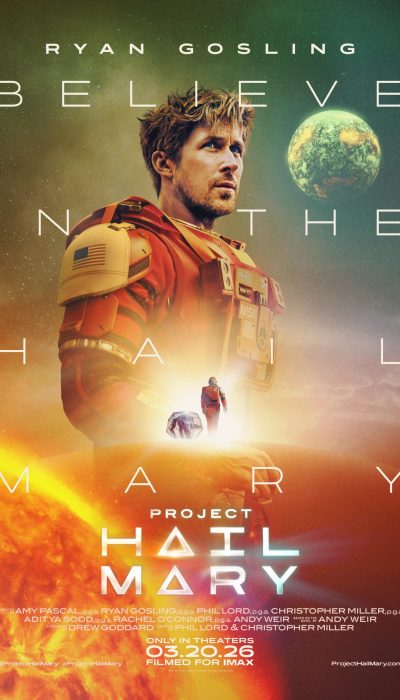
Its development reflects that same instinct for intelligence over spectacle. What appears on screen feels less like a risk than the natural outcome of disciplined alignment between material, collaborators, and timing.
THE WRONG MAN FOR THE RIGHT JOB
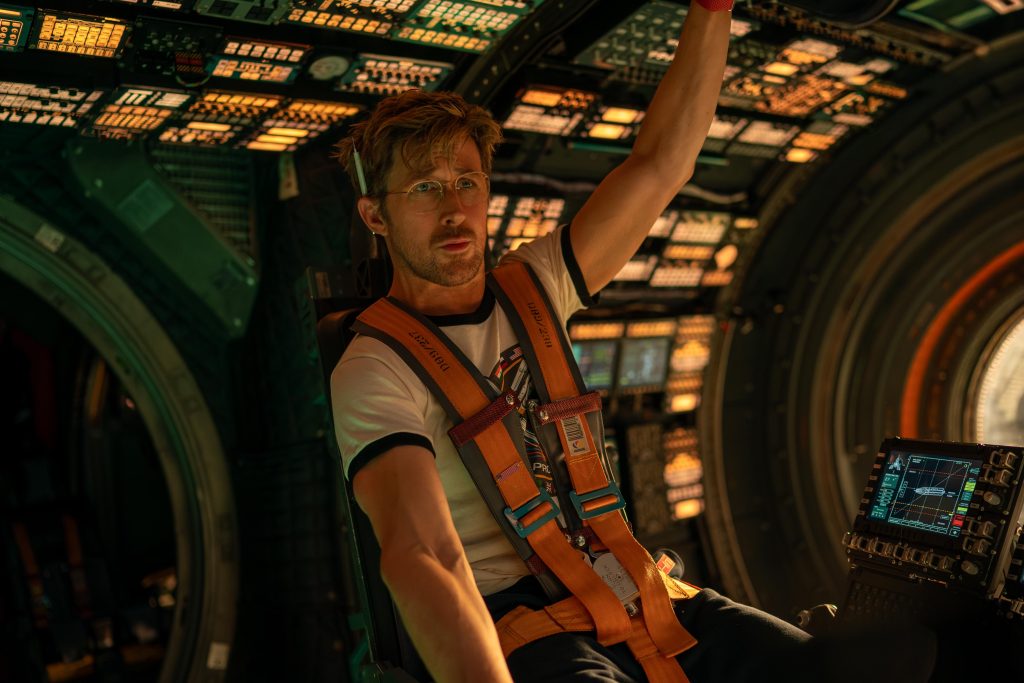
Dr. Ryland Grace, the character at the centre of the film, is not a conventional hero. A molecular biologist and former middle-school science teacher, he is recruited against his will to confront a crisis that threatens humanity’s survival. When he awakens alone aboard a spacecraft, 12 light-years from Earth in the distant Tau Ceti star system, with no memory of how he got there, he is left to piece together both the mission and his role within it. By any reasonable measure, he is the wrong man for the assignment, which, ultimately, is precisely the point.
Gosling approaches the character without the bravado the genre often demands. There are no grandstanding speeches or displays of cinematic invincibility. Grace thinks aloud, falters, recalibrates, and continues. The performance is grounded in recognisable human instinct rather than mythic heroism, shaped in part by what Gosling has described as “the most challenging film I’ve ever done.” Long stretches of technical isolation and performance precision lend the portrayal a lived-in authenticity that anchors the film’s larger premise.
Standing firmly in Grace’s orbit is Eva Stratt, portrayed by Sandra Hüller, whose Oscar-nominated turn in Anatomy of a Fall introduced her to global audiences. As the administrator charged with coordinating Earth’s response, she embodies a pragmatic, unsentimental authority. Stratt is the one who places Grace on that spacecraft, and she does so with unwavering resolve. Hüller’s performance anchors the film’s speculative elements in a recognisable moral reality.
ROCKY
The film’s most unexpected emotional register arrives through Rocky, a five-limbed alien engineer who has spent decades near Tau Ceti working the same astrophysical mystery from his side of the universe. Communicating through musical tones and unable to survive in Earth-like atmospheric conditions, Rocky was realised on set through a team of performers led by puppeteer James Ortiz. The decision to create a tangible physical presence, rather than rely entirely on digital effects, proves crucial. Gosling was able to respond to a fully embodied character, lending warmth and spontaneity to the evolving friendship between the two stranded scientists.
“The soul of the story is empathy and communication,” Gosling has said, “and we realised we had a movie because we could show how difficult that process really is.”
As Grace and Rocky construct a shared language from mathematics and music, the story reveals its central conviction: connection remains possible even across the most unimaginable distances.
BUILT TO BE SEEN
The directors have spoken about their ambition to balance the solitude of deep space with a sense of wonder, an emotional duality that informs both the film’s visual scope and its narrative momentum. Shot on ARRI Alexa 65 cameras and formatted specifically for IMAX presentation, the production was conceived as an immersive theatrical experience. The vast emptiness of space, the confined intimacy of the spacecraft interior, and the unfamiliar beauty of Rocky’s environment achieve their full effect when projected at monumental scale. Composer Daniel Pemberton’s score, finely attuned to the shifting emotional currents between Grace and Rocky, deepens that immersion. At a moment when many films transition quickly to streaming platforms, this one makes a confident case that some stories are simply meant to be seen on the biggest screen possible and felt in the dark, with nowhere else to be.
WHAT COMES NEXT
Born in London, Ontario, Gosling has always carried a distinctly Canadian steadiness to how he builds a career, and at 45, the trajectory now suggests expansion rather than reinvention. Over two decades, he has moved with notable precision between intimate character studies and culturally dominant productions, from Half Nelson and Blue Valentine to Drive, La La Land, and the global phenomenon of Barbie. With Project Hail Mary, he enters the realm of original large-format spectacle as a creative architect shaping the framework around the work itself, not merely as a leading man. Next up is Star Wars: Starfighter, directed by Shawn Levy and set for Memorial Day weekend 2027, where Gosling takes on the role of a Jedi, a universe he kept at arm’s length for most of his career. “I just avoided these things because they never felt right,” he has said. “And I’m glad I did because it was worth waiting for.” If General Admission represents the infrastructure of this next chapter, the reception to his latest film suggests that audiences are already attuned to where it may lead.
In the film, the mission succeeds not because the odds were favourable (they never were) but because the right person refused to give up on it. Some long shots, it turns out, are anything but.